Whispers of the Ancient World: Walking Through Delphi’s Living Public Spaces
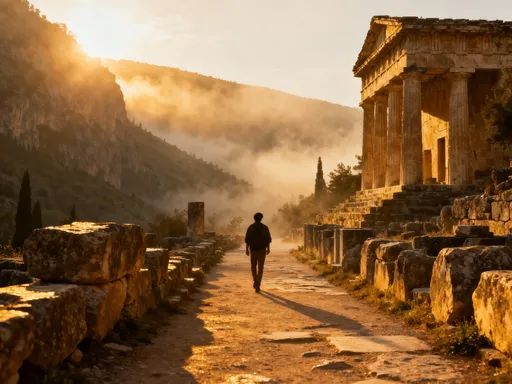
Have you ever stood where history breathed? In Delphi, Greece, the stone paths, terraced sanctuaries, and open-air ruins aren’t just relics—they’re living public spaces where myth, democracy, and daily life once converged. I walked through the Sacred Way as morning light warmed the ancient stones, and suddenly, the past wasn’t distant. It was tangible, echoing in the wind above the valley. This is more than a ruins tour—it’s an immersion into how people gathered, worshipped, and governed in one of antiquity’s most revered sites. Delphi was not merely a temple or oracle; it was a dynamic civic center, a crossroads of faith and policy, sport and song, where Greeks from every city-state came to participate in a shared cultural rhythm. To walk Delphi today is to step into a conversation that began over two thousand years ago—one still whispered through the olive trees and carried on the mountain breeze.
Approaching Delphi: A Journey Above the Clouds
Reaching Delphi is itself a transformation. The journey begins in the lowlands of central Greece, where olive groves sprawl across sun-drenched hills and modest villages cling to the contours of the land. As the road climbs higher into the folds of Mount Parnassus, the air grows cooler and clearer. The switchbacks tighten, and with each turn, the modern world recedes. Telephone wires thin out, village chapels give way to clusters of cypress trees, and the scent of wild thyme rises from the rocky soil. It is as if the ascent is not only physical but spiritual—a gradual shedding of everyday distractions in preparation for what lies ahead.
At approximately 600 meters above sea level, Delphi emerges not with fanfare but with quiet dignity. Nestled into the steep mountainside, the site overlooks the deep gorge of the Pleistos River, its terraced ruins cascading downward like stone petals. In antiquity, this elevation was no accident. The location was deliberately chosen to inspire awe and reverence. Perched between two imposing cliffs, Delphi was believed to be the center of the world—the mythical omphalos, or navel, where heaven and earth met. Its inaccessibility added to its sanctity; pilgrims traveled for days from Athens, Corinth, or even distant Asia Minor, their footsteps converging on this sacred midpoint.
What made Delphi a true pan-Hellenic public space was its unifying power. Despite the rivalries between Greek city-states, all recognized Delphi as a neutral ground. Here, diplomacy could unfold under divine auspices, treaties were sworn before Apollo, and disputes were sometimes settled by oracle. The journey upward mirrored the journey inward—a pilgrimage not only of distance but of intention. Even today, as visitors arrive by car or bus, the sense of transition remains. The panoramic views stretch across the valley, where light plays on the folds of the landscape, and the silence between gusts of wind feels intentional, as if the mountain itself is listening.
The Sanctuary of Apollo: Where Religion Met Public Life
At the heart of Delphi lies the Sanctuary of Apollo, a complex of sacred structures arranged along a terraced slope. This was not a secluded temple hidden from view but a vibrant public forum where religion and civic engagement intertwined. The Temple of Apollo, its foundations still visible, once housed the famed Oracle—the Pythia—who delivered cryptic prophecies believed to come directly from the god. But the sanctuary was more than a place of divination. It functioned as a religious, political, and judicial hub, where decisions of great consequence were shaped by divine interpretation.
The altar before the temple, large enough to accommodate communal sacrifices, was central to both ritual and social cohesion. These ceremonies were public events, attended by delegations from across Greece. The smoke of burning offerings rose as a visible symbol of unity, a shared act of piety that transcended local allegiances. Nearby stood the stoa, a long colonnaded building that served as a gathering place for visitors, a shelter from sun or rain, and a venue for philosophical discussion. Inscriptions on stone record treaties, manumissions of slaves, and dedications from city-states—all testaments to the sanctuary’s role in public life.
What made the Oracle so influential was not just her spiritual authority but her timing. Leaders consulted her before wars, colonization efforts, and the founding of new cities. The Athenians, for instance, sought her advice before building their fleet that would later defeat the Persians at Salamis. Croesus, king of Lydia, famously asked whether he should attack Persia; the oracle’s ambiguous reply—that a great empire would fall—became a cautionary tale about the limits of human understanding. Thus, the sanctuary was not isolated from politics but deeply embedded in it, a place where divine will and human ambition intersected.
Moreover, the site hosted the Pythian Games, held every four years in honor of Apollo’s victory over the serpent Python. These games, second only to the Olympics in prestige, drew athletes, musicians, and poets from across the Greek world. The sanctuary, therefore, was not static but cyclical—its rhythm marked by festivals, processions, and competitions that brought life to the stones. In this way, Delphi was not merely a place of worship but a living calendar of communal experience.
The Sacred Way: A Processional Path of Memory and Movement
Ascending from the entrance of the sanctuary, the Sacred Way winds upward like a spine connecting the various organs of Delphi’s public life. This cobblestone path, worn smooth by centuries of footsteps, was the main artery of ritual movement. Pilgrims, athletes, and dignitaries all walked this route, their steps guided by faith, duty, or celebration. Along both sides stand the remains of small buildings known as treasuries—modest yet ornate structures erected by individual city-states to honor Apollo and display their civic pride.
The Athenian Treasury, reconstructed from original fragments, stands as one of the best-preserved examples. Built to commemorate a naval victory, it was both an offering and a statement—a declaration of Athens’ power and piety. Other city-states, from Sicyon to Thebes, followed suit, each treasury a miniature monument to local identity within a shared Hellenic culture. These were not mere storage rooms for votive gifts but early forms of public representation, akin to national pavilions at a world exposition. They allowed city-states to assert their presence in a sacred space that belonged to no one and everyone at once.
During the Pythian Games, the Sacred Way came alive with processions. Choruses sang hymns, athletes carried olive branches, and priests led sacrificial animals toward the altar. The atmosphere would have been festive yet solemn, a blend of pageantry and devotion. The path itself, with its gradual incline, encouraged contemplation. Each step upward was a movement toward clarity, a physical manifestation of spiritual ascent. Even today, walking the Sacred Way evokes a sense of progression—not just through space, but through time.
The treasuries also served as memory keepers. Inscribed with dedications and historical records, they preserved the stories of victories, alliances, and divine favors. In an era before mass communication, these stone archives were vital. They allowed visitors to read the collective history of the Greek world, to see how their city fit into a larger narrative. The Sacred Way, therefore, was not only a route but a story—a curated journey through the values, ambitions, and beliefs of ancient Greece.
The Theater of Delphi: Voices in the Open Air
Perched on the mountainside above the sanctuary, the Theater of Delphi offers one of the most breathtaking settings of any ancient performance space. With seating for around 5,000 spectators, it was carved directly into the rock, its semicircular rows rising like steps toward the sky. The stage, though partially ruined, still conveys the elegance of its original design. But what truly distinguishes this theater is its integration with the natural landscape. From every seat, the audience enjoyed panoramic views of the valley below, where clouds sometimes drift like ghosts between the peaks.
The theater was primarily used during the Pythian Games for musical and dramatic competitions. Poets recited odes, musicians played the kithara and aulos, and tragic choruses performed works dedicated to Apollo. Unlike the Olympics, which focused on athletic prowess, the Pythian Games celebrated artistic excellence, reinforcing the Greek ideal of kalokagathia—the unity of moral and physical virtue. The acoustics of the theater, enhanced by its concave shape and stone construction, allowed even the softest voice to carry clearly to the highest row. A whisper on stage could be heard as if spoken nearby—a feat of ancient engineering that still impresses modern visitors.
But the theater was not reserved solely for entertainment. It also served as a venue for civic assemblies, where religious officials and city representatives gathered to discuss matters of shared concern. In this dual role, it embodied the Greek belief that culture and governance were inseparable. Beauty was not a luxury but a civic duty; music and poetry were not diversions but tools of moral education. The design of the theater reinforced this idea—by placing the audience in a shared visual and auditory field, it created a sense of unity. Thousands could see the same horizon, hear the same words, and feel part of a collective moment.
Today, the theater is occasionally used for performances during summer festivals, reviving its ancient purpose. When a singer stands on the stage and begins a melody, the sound rolls through the air as it did two millennia ago. In those moments, the boundary between past and present thins. The theater remains a powerful symbol of how public spaces can elevate the human voice—literally and figuratively—giving form to shared values and communal memory.
The Stadium: Where Competition Shaped Community
Higher still, past the theater, lies the stadium of Delphi—a simple yet imposing structure perched at the very edge of the mountain. With a racecourse approximately 177 meters long, it hosted the athletic events of the Pythian Games, including footraces, wrestling, and the pentathlon. Unlike the grand stadiums of later Roman times, Delphi’s stadium retains a sense of austerity. Its stone seating follows the natural curve of the hill, and the starting and finishing lines are still visible in the worn rock. There are no elaborate arches or imperial inscriptions—only the essentials, focused on the purity of competition.
The athletes who competed here came from across the Greek world, representing their cities not for monetary reward but for honor and divine favor. Victory at Delphi was considered second only to Olympic triumph. Winners received a laurel wreath cut from the sacred grove of Apollo, a symbol of both athletic excellence and spiritual blessing. The simplicity of the prize underscores a deeper value: that true glory lies not in material wealth but in effort, discipline, and recognition by one’s peers.
Sports in ancient Greece were never merely recreational. They were a form of civic education, shaping the character of young men and reinforcing social cohesion. The Pythian Games, held in the fourth year of each Olympiad cycle, brought together Greeks from often-warring states in peaceful competition. In this way, the stadium was a space of reconciliation, where rivalry was channeled into constructive energy. The shared rules, the common language of gesture and contest, created a sense of belonging to a larger Hellenic identity.
Walking through the stadium today, one can almost hear the echo of starting commands, the rhythm of pounding feet, the roar of the crowd. The wind sweeps across the open track, carrying with it the memory of effort and endurance. The absence of modern amenities—the lack of scoreboards, loudspeakers, or advertising—only deepens the connection to the past. This was a place where the body was honored as a vessel of virtue, where competition served not to divide but to unite.
The Hippodrome and Lost Spaces: Imagining the Full Social Fabric
Not all of Delphi’s public life is visible today. The hippodrome, where chariot races were once held, has not survived in any identifiable form. Ancient texts mention it, but its exact location remains uncertain, likely eroded by time or buried beneath later landslides. This absence is a reminder that what we see now is only a fragment of the past. The ruins on display represent the monumental—the temples, theaters, and treasuries—but much of daily life occurred in spaces that left no stone behind.
Markets, informal gathering spots, shaded walkways, and spaces for philosophical debate must have existed between the formal structures. Travelers would have rested under olive trees, traders sold food and souvenirs, and philosophers engaged in dialogue on stone benches. These ephemeral zones were just as vital to Delphi’s function as a public space. They were where ideas were exchanged, friendships formed, and the rhythm of human interaction unfolded beyond ritual and ceremony.
The loss of these areas challenges us to imagine the full texture of ancient social life. We know from inscriptions and literary sources that Delphi was bustling during festival seasons. Pilgrims stayed in nearby inns, vendors set up temporary stalls, and musicians performed in open courtyards. The sanctuary was not a silent museum but a living city during peak times. The absence of the hippodrome, therefore, is not just a gap in the archaeological record but an invitation to reflection: public life is not only built in stone but sustained in movement, conversation, and presence.
Modern visitors often focus on the grand monuments, but the true spirit of Delphi lies in the spaces between—the pathways, the pauses, the moments of quiet observation. Just as the Oracle’s voice was not constant but episodic, so too was the pulse of public life: intense during festivals, quieter in between, but always present in memory and tradition. To honor Delphi fully is to recognize that community is not only shaped by architecture but by the invisible threads of shared experience.
Delphi Today: Between Tourism and Timeless Space
In the 21st century, Delphi is a UNESCO World Heritage Site and one of Greece’s most visited archaeological destinations. Thousands of tourists walk the Sacred Way each year, guided by maps, audio devices, and the signs of modern heritage management. Preservation efforts have stabilized the ruins, reconstructed key structures like the Athenian Treasury, and improved accessibility with pathways and railings. These measures ensure that Delphi remains open to all, safeguarding its stones for future generations.
Yet with increased visitation comes the challenge of balance. How does one honor the sanctity of a place while accommodating the needs of modern tourism? Crowds can disrupt the contemplative atmosphere, and commercial activities—cafes, gift shops, tour groups—inevitably reshape the experience. Some visitors rush through in under an hour, snapping photos without pausing to feel the weight of the place. Others sit quietly on a step, listening to the wind, and seem to touch something deeper.
What endures is Delphi’s ability to inspire reflection. Whether one believes in oracles or not, the site carries an emotional resonance. It speaks to the human need to gather, to seek meaning, and to mark important moments in shared spaces. The same impulses that drew ancient Greeks to Delphi—curiosity, reverence, community—are still alive today. Modern public squares, town halls, and cultural festivals fulfill similar roles, even if the gods have changed.
Delphi is not frozen in time. It lives in the footsteps of those who walk it, in the questions they carry, and in the silence they find. It reminds us that public spaces are not just physical locations but vessels of collective memory. They shape who we are by reminding us of who we have been. To walk Delphi is to participate in a tradition older than nations, older than written records—a tradition of coming together, of listening for whispers in the wind, and of believing, even for a moment, that we stand at the center of the world.