You Gotta See How Tangier’s Urban Pulse Comes Alive
Tangier isn’t just a city—it’s a living rhythm of street sounds, colors, and cultures colliding in the most beautiful way. I walked its alleys expecting history, but found something deeper: how people shape urban space with everyday life. From spontaneous markets to coastal stairways buzzing with energy, Tangier teaches you to *feel* a city, not just see it. This is urban travel at its most real—raw, human, and impossible to forget. The city pulses with an authenticity that polished destinations often lack. Here, life spills into the streets, conversations unfold on doorsteps, and the urban fabric is woven not by architects alone, but by generations of residents who adapt, improvise, and belong.
First Impressions: Where Africa Meets Europe
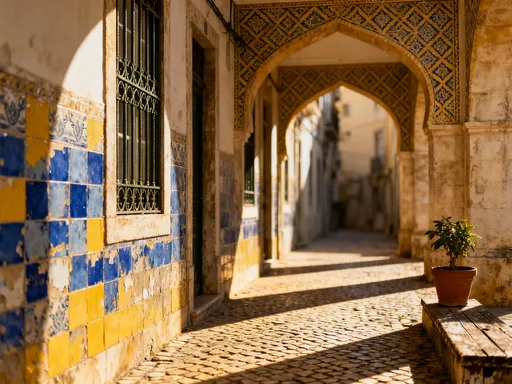
Arriving at Tangier Ville station, travelers are immediately immersed in a city that refuses to be defined by a single identity. The architecture tells the first chapter of this story—French colonial buildings with pastel facades stand shoulder to shoulder with traditional Moroccan riads, their carved wooden doors hinting at centuries of craftsmanship. The air carries a layered soundtrack: the melodic call to prayer from a nearby minaret blends with the persistent honking of petit taxis and the chatter of vendors calling out prices in Arabic, French, and Tamazight. This sensory blend is not chaotic; it is harmonious in its complexity, a testament to Tangier’s role as a crossroads between continents.
What sets Tangier apart from other North African cities is its openness. Unlike more insular urban centers, Tangier has long served as a gateway—first for traders, then diplomats, artists, and now global travelers. Its location at the western entrance of the Strait of Gibraltar places it within sight of Europe, and that proximity has shaped its character. You can taste it in the café menus offering both mint tea and espresso, see it in the fashion where djellabas mix with denim, and feel it in the pace of life, which balances Moroccan ease with Mediterranean liveliness.
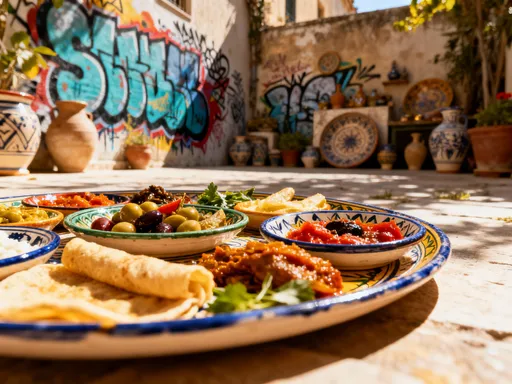
The city’s graffiti adds another dimension to this cultural dialogue. On one wall, political slogans in bold Arabic script speak to national pride; on another, abstract street art painted in vibrant hues reflects global artistic trends. These visual layers mirror the city’s layered identity—one that does not erase its past but builds upon it. For the observant traveler, every corner offers a clue to how Tangier’s people negotiate tradition and modernity in their daily lives.
The Medina’s Living Maze: More Than Just Alleys
The old medina of Tangier is not merely a tourist attraction; it is a fully functioning ecosystem of urban life. Its narrow, winding alleys are not designed for efficiency but for intimacy. Walking through them, one quickly realizes that these pathways are not just for transit—they are social corridors where neighbors exchange news, children chase each other between stalls, and shopkeepers invite passersby to sample fresh dates or sniff bottles of argan oil. The medina breathes with activity from dawn until late evening, its rhythm dictated not by clocks but by the natural flow of community life.
What makes this space truly unique is how residents extend their private lives into public view. Doorways become seating areas where families gather in the cool of the evening. Rooftops, accessible via steep stone staircases, serve as private terraces for drying laundry, hosting guests, or simply watching the sunset over the sea. Courtyards tucked behind unassuming doors reveal lush gardens and fountains—hidden oases that contrast with the bustling streets just steps away. These spaces are not architectural afterthoughts; they are essential components of daily living, reflecting a culture that values connection and shared experience.
The informal economy thrives within this network. A shoe shiner sets up his box near a busy intersection, offering quick service between appointments. Spice vendors display colorful pyramids of cumin, saffron, and paprika in reused glass jars, their fragrances mingling in the air. Tea vendors move through the crowds with brass trays, balancing glasses of steaming mint tea with practiced ease. These micro-businesses are not disruptions to urban order—they are its foundation. They create a sense of continuity and familiarity, where every vendor knows their regular customers by name and preference.
This organic economic system also demonstrates remarkable adaptability. During festivals or religious holidays, the same spaces transform to accommodate increased foot traffic, with temporary stalls appearing overnight and communal meals shared in open plazas. There is no rigid zoning here—space is fluid, repurposed according to need. For visitors, this offers a rare glimpse into a city that operates on human scale rather than bureaucratic design.
Grand Socco: The Breathing Center of the City
At the edge of the medina lies the Grand Socco, a vast circular plaza that functions as Tangier’s urban lung. By morning, it is a marketplace alive with energy—vendors unpack crates of tomatoes, onions, and citrus fruits, arranging them in neat rows on woven mats. The scent of fresh produce mingles with the earthy aroma of bundled herbs. Farmers from nearby villages arrive with their harvests, engaging in animated bargaining that blends commerce with conversation. This is not a transactional space alone; it is a place of exchange in the broadest sense, where news, recipes, and family updates are traded along with goods.
As the day progresses, the Grand Socco shifts its role. By mid-afternoon, the market winds down, and the plaza becomes a gathering point. Young people sit on low stone walls, sharing music through cracked phone speakers. Elders sip coffee at small tables outside cafés, watching the world pass by. Children kick a worn football across the open space, weaving between pedestrians with practiced agility. The surrounding green spaces—modest but well-tended—offer shade and respite, their benches occupied by those seeking a moment of rest or connection.
What makes the Grand Socco so effective is its lack of rigid programming. There are no strict rules about how the space should be used, yet an informal order emerges naturally. Pedestrians intuitively navigate around impromptu games, vendors respect designated zones, and locals know where to find their favorite juice stand or bread seller. This self-regulating system speaks to a deep communal understanding of shared space—one that does not rely on signage or enforcement but on mutual respect and routine.
Evening brings another transformation. As the sun dips below the hills, families return to the plaza, strolling in loose groups, pausing to buy snacks or simply enjoy the cooler air. The lighting—soft and warm—enhances the sense of safety and welcome. For many residents, the Grand Socco is not just a place to go; it is a ritual, a daily touchpoint that grounds them in the rhythm of the city. For visitors, it offers a masterclass in how public spaces can foster belonging without pretense.
Modern Tangier: Contrasts in Concrete and Glass
Just beyond the historic core, a different Tangier emerges—one of wide boulevards, glass-fronted shopping centers, and high-rise residential towers. Districts like Tangier City Center represent the city’s aspirations toward modernity and economic growth. These areas feature landscaped plazas, underground parking, and international retail brands, catering to a growing middle class and an influx of investors. The architecture is sleek, the sidewalks are wide, and the lighting is bright—everything appears designed for comfort and convenience.
Yet this modernity exists in constant dialogue with the older city. While the new districts offer climate-controlled malls and predictable layouts, they often lack the spontaneity and warmth of traditional spaces. A shopping mall may have seating, but it rarely becomes a true gathering place. A plaza may be aesthetically pleasing, but without vendors, street performers, or informal games, it feels sterile compared to the Grand Socco. The challenge lies in balancing efficiency with humanity—creating spaces that serve modern needs without sacrificing the social fabric that defines Tangier.
Some newer developments are beginning to learn from the old. Public parks incorporate shaded walkways and water features inspired by Andalusian gardens. Mixed-use buildings combine retail, offices, and apartments, encouraging foot traffic throughout the day. In certain zones, local artisans are invited to set up temporary kiosks during weekends, reintroducing the informal economy into formal spaces. These efforts suggest a growing awareness that urban success is not measured solely by economic output but by the quality of human experience.
The tension between old and new is not a flaw—it is a dynamic force. It pushes the city to evolve while reminding its residents of what makes it unique. For the traveler, this contrast offers a richer understanding of Tangier’s identity. One can admire the ambition of modern construction while appreciating the wisdom embedded in centuries-old urban patterns. The true beauty lies not in choosing between them but in seeing how they coexist, each shaping the other in subtle ways.
Streets as Stages: Daily Life in Motion
In Tangier, the street is never just a route from one place to another—it is a stage for daily life. Sidewalks double as workshops where metalworkers hammer out lanterns, tailors stitch garments on treadle machines, and barbers offer quick trims on folding chairs. Playgrounds emerge spontaneously: a flattened cardboard box becomes a tabletop football field, a taped-up tennis ball turns any alley into a soccer pitch. Even in the busiest districts, there is room for improvisation, a testament to the city’s resilience and creativity.
This adaptive use of space reflects a deep cultural value: making do, but making it meaningful. When official infrastructure is lacking—whether benches, playgrounds, or community centers—people create their own solutions. A flight of concrete steps becomes a favorite meeting spot for teenagers. A patch of vacant land fills with folding tables where men play dominoes under a single streetlamp. These moments are not signs of neglect but expressions of agency. They show how communities assert ownership over their environment, shaping it according to their needs and rhythms.
What makes this possible is a shared understanding of tolerance and coexistence. A food cart operates inches from a shoemaker’s station, and neither complains about the proximity. Children play near delivery trucks unloading goods, moving aside instinctively when necessary. There is an unspoken agreement that space is communal, not private—something to be shared, negotiated, and enjoyed collectively. This ethos reduces friction and fosters a sense of mutual responsibility.
For visitors, observing these interactions offers a powerful lesson in urban living. In many cities, strict zoning separates functions—work here, play there, live elsewhere. Tangier blurs these lines, creating a more integrated, vibrant experience. It reminds us that cities are not just collections of buildings but networks of relationships. When designed—or even just used—with humanity in mind, they become places of connection, not isolation.
Coastal Edges: Where the City Meets the Sea
The Corniche, Tangier’s seaside promenade, is one of its most beloved public spaces. Stretching along the Atlantic coast, it serves as both escape and artery—a place to unwind and a route connecting neighborhoods. By day, fishermen mend their nets on the docks, their boats bobbing gently in the harbor. The scent of salt and grilled sardines fills the air. By evening, families stroll hand in hand, couples sit on stone walls watching the waves, and teenagers gather to listen to music or practice dance moves.
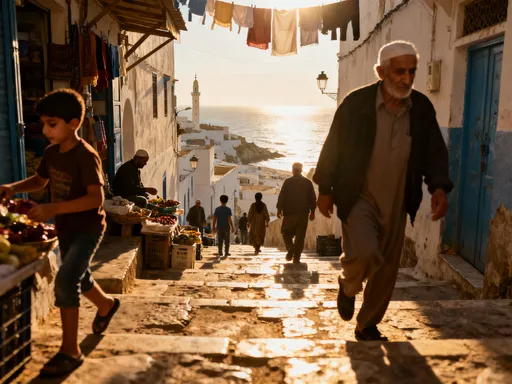
What makes the Corniche special is its accessibility. Unlike exclusive beach clubs or gated resorts, this space belongs to everyone. Fishermen use the docks not just for work but as viewing platforms, where they sip tea and watch the sunset. Seaside staircases, carved into the cliffs, become informal meeting zones—places to catch up with neighbors or enjoy a quiet moment alone. There are no admission fees, no dress codes, no restrictions. This openness fosters a rare sense of inclusion, where social differences melt away in the presence of the sea.
The natural geography of Tangier plays a crucial role in shaping urban life. The hills force streets to curve and climb, creating unexpected vistas at every turn. The proximity to water moderates the climate, making outdoor living pleasant year-round. Even the wind—a constant presence—shapes behavior, influencing where people sit, how they dress, and when they choose to be outside. Urban planners in other cities often fight nature; in Tangier, the city dances with it, adapting to its rhythms rather than resisting them.
This integration of nature and city is not accidental. For generations, Tangier’s residents have understood that the sea is not just a backdrop but a vital part of daily existence. It provides food, livelihoods, and beauty. It calms the mind and inspires the spirit. To walk the Corniche is to experience a city that knows how to live with its environment, not against it—a lesson increasingly relevant in an age of climate challenges and urban isolation.
Getting Around: A Local’s View on Transit and Walkability
Navigating Tangier requires a mix of patience, observation, and a willingness to embrace unpredictability. The city’s topography—hilly, uneven, and organically developed—means that walking is both rewarding and challenging. Some routes involve long climbs, while others descend abruptly into quiet alleys. Sidewalks appear and disappear, forcing pedestrians to share the road with scooters and taxis. Yet for those who move slowly and pay attention, the journey becomes part of the experience, revealing hidden courtyards, street art, and impromptu conversations.
For longer distances, petit taxis are the most practical option. These small, often brightly colored vehicles are affordable and abundant, but they operate without meters in many cases, so agreeing on a price before departure is essential. Drivers usually speak some French or basic English, and many enjoy chatting with passengers, offering recommendations or sharing stories about the city. Buses serve major routes, particularly between the city center and newer suburbs, but schedules can be irregular, and signage is primarily in Arabic and French, which may pose challenges for non-speakers.
Safety is generally not a concern for visitors who exercise common sense. Tangier is accustomed to travelers, and locals are typically helpful, especially when they see someone looking lost. Asking for directions often leads to a friendly escort part of the way, or an offer of tea from a shopkeeper who overheard the conversation. Signage is improving but still inconsistent, so using a map app with offline capability is advisable. Accessibility remains limited—cobblestone streets, steep stairs, and narrow doorways can make navigation difficult for those with mobility challenges.
The key to moving like a local is to accept that efficiency is not the goal. Rushing through Tangier means missing its essence. Instead, allow time for detours, for conversations with vendors, for sitting at a café and watching the street. The city rewards those who slow down, who listen, who engage. It teaches a different kind of navigation—one based on intuition, connection, and presence.
Conclusion: Why Tangier’s Urban Soul Stays With You
Tangier leaves an imprint not because of its landmarks, but because of its life. Its streets are not designed for perfection but for people—flawed, vibrant, and full of spirit. In an era when many cities prioritize control, cleanliness, and commercial appeal, Tangier stands as a reminder that urban beauty often lies in the unpolished, the improvised, the human. It is a city that does not hide its seams but wears them proudly, letting them tell the story of resilience, adaptation, and community.
Travelers who come seeking only monuments may leave unsatisfied. But those who come to understand how people live—the way a grandmother calls her grandchild from a rooftop, how friends share a single cigarette on a bench, how a street becomes a stage for a thousand small dramas—will find something lasting. Tangier teaches us that the soul of a city is not in its skyline, but in its sidewalk cracks, where life finds a way to grow.
To explore Tangier is to embrace a different way of seeing urban spaces—not as static destinations, but as living, breathing entities shaped by daily acts of belonging. It invites us to look beyond guidebooks and curated experiences, to engage with the messy, beautiful reality of human connection. In doing so, we do not just visit a place—we become part of its rhythm, if only for a moment. And that moment, fleeting as it may be, stays with us long after we’ve left its shores.