You Won’t Believe These Hidden Gems in Lisbon
Lisbon is more than trams and tile-covered streets — it’s a city whispering secrets through its forgotten walls and quiet alleys. I wandered far from the tourist maps and found architectural wonders no guidebook warned me about: surreal staircases, Moorish echoes, and art nouveau whispers in overlooked neighborhoods. These hidden structures aren’t just beautiful — they tell stories of resilience, fusion, and identity. If you’re ready to see Lisbon through a different lens, stick around. This is architecture with soul.
Beyond the Postcard: Rethinking Lisbon’s Architectural Identity
Lisbon’s fame often rests on its iconic postcard sights: the golden glow of Belém Tower at sunset, the cobbled climb through Alfama’s winding lanes, and the commanding silhouette of São Jorge Castle above the Tagus River. These landmarks are undeniably significant, each a chapter in the city’s long and layered history. Belém Tower, a UNESCO World Heritage site, stands as a symbol of Portugal’s Age of Discovery, its ornate Manueline carvings echoing the maritime ambitions of the 16th century. Meanwhile, the medieval fortress of São Jorge offers panoramic views and a tangible sense of the city’s defensive past, once pivotal in resisting Moorish and Castilian invasions.
Yet for all their grandeur, these well-trodden attractions offer only a partial portrait of Lisbon’s architectural soul. They represent moments of national pride and historical spectacle, but they don’t capture the everyday poetry of the city — the quiet beauty embedded in its residential corners, forgotten courtyards, and repurposed spaces. The true depth of Lisbon’s built environment lies beyond the souvenir shops and crowded viewpoints, in neighborhoods where history wasn’t preserved behind velvet ropes but lived in, adapted, and transformed across generations.
What makes Lisbon architecturally compelling is not just its famous facades, but the way its urban fabric reveals centuries of cultural convergence. Beneath the surface of its tiled exteriors are traces of Roman foundations, Moorish urban planning, and the seismic shifts brought by the devastating 1755 earthquake. That catastrophe reshaped the city’s core, giving rise to the Pombaline grid in Baixa — one of Europe’s first seismically engineered urban plans. But beyond this reconstructed center, older patterns persist: organic alleyways, irregular plots, and hybrid designs born of necessity and cultural exchange.
To understand Lisbon fully, one must look beyond the curated narratives of tourism and embrace the city’s quieter, more intimate expressions. These are the spaces where architecture isn’t about monumentality but about memory — where every cracked tile, weathered beam, and asymmetrical window tells a story of survival, adaptation, and quiet dignity. The city’s identity isn’t confined to its castles and towers; it pulses in the overlooked corners where history wasn’t frozen, but allowed to evolve.
The Magic of Mouraria: Where Cultures Built Together
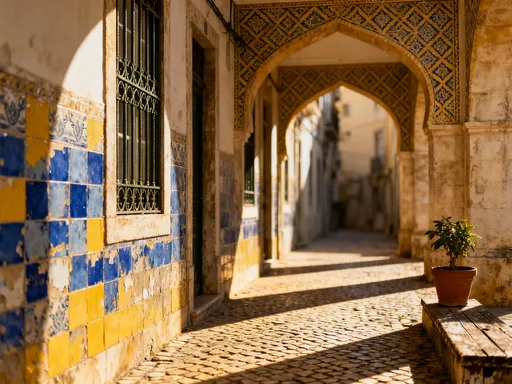
Nestled between the historic hills of Alfama and the bustling Martim Moniz square, Mouraria is a neighborhood that breathes cultural fusion. Once home to the city’s Moorish population after the Christian reconquest in 1147, it has long been a crossroads of identities, languages, and traditions. This rich heritage is not just remembered in festivals or music — it is physically inscribed in the very walls, doorways, and courtyards of the district. Walking through Mouraria feels like tracing the outlines of a living mosaic, where Islamic design principles quietly harmonize with Portuguese craftsmanship.
The architecture here defies easy categorization. Narrow alleyways twist unpredictably, a legacy of pre-earthquake urban planning that prioritized shade and airflow over symmetry. Buildings lean gently against one another, their facades a patchwork of stucco, exposed stone, and the ever-present azulejos — hand-painted ceramic tiles that often feature geometric patterns reminiscent of North African zellige work. In some courtyards, horseshoe arches peek from behind ivy-covered walls, their soft curves echoing the architectural language of Al-Andalus. These aren’t recreations or tourist pastiches; they are authentic remnants of a time when Muslim, Jewish, and Christian communities coexisted in close proximity, shaping the city’s physical form through daily life.
After the 1755 earthquake, much of Lisbon was rebuilt under a rational, grid-based plan. But Mouraria, already dense and irregular, resisted full reconstruction. Instead, it underwent adaptive reuse — damaged structures were repaired, repurposed, and layered with new elements. This organic evolution gave rise to hybrid forms: a ground-floor workshop with a vaulted ceiling supported by centuries-old stone ribs, now housing a family-run bakery; a shared patio where a Moorish-style fountain still trickles beneath a tiled awning. These spaces were not designed for spectacle but for living — their beauty emerging from function, not ornamentation.
What makes Mouraria truly special is its sense of continuity. Unlike gentrified districts where history is polished into aesthetic themes, here, the past is not curated — it is lived. Residents still gather in shared courtyards, children play beneath arched passageways, and the scent of grilled sardines mingles with the damp stone after rain. The architecture supports this way of life, with thick walls that keep interiors cool, small windows that protect privacy, and interconnected spaces that foster community. To walk through Mouraria is to witness how culture becomes structure — not through grand declarations, but through the quiet accumulation of daily habits, shared memories, and resilient buildings.
Hidden Courtyards of Graça: Peace in Plain Sight
Perched on one of Lisbon’s seven hills, the Graça neighborhood offers sweeping views of the city and the river beyond. Yet some of its most moving architectural experiences are not found in vistas, but in the quiet intimacy of its hidden courtyards. Tucked behind unassuming wooden doors or iron gates, these interior patios are oases of stillness in a bustling city. Many are accessible only through chance — a friendly nod from a resident, a misstep down a narrow passage, or a conversation sparked on a sunlit bench. But for those who find them, these spaces offer a rare glimpse into Lisbon’s domestic soul.
The architecture of these courtyards reflects a deep understanding of climate and community. Built into the steep terrain, homes in Graça often stack vertically, with upper floors accessed by external staircases lined with blue-and-white tiles. The courtyards themselves serve multiple purposes: they provide natural light to interior rooms, promote airflow in the Mediterranean heat, and create semi-private zones where neighbors can interact without fully exposing their private lives. Wrought-iron railings, often decorated with floral motifs, encircle balconies, while stone water fountains — some still functional — stand as quiet monuments to a time when water was drawn daily from communal sources.
One such courtyard revealed itself during a late afternoon walk. After pausing to rest on a bench, I struck up a conversation with an elderly woman tending to potted geraniums. She invited me through a half-open door into a walled garden no wider than ten meters, yet layered with history. The walls were covered in azulejos depicting pastoral scenes from the 18th century, their colors softened by time. A vaulted ceiling, supported by ancient brick ribs, sheltered a small seating area where three neighbors sat sipping coffee. The air was cool, the sound of traffic muffled by the surrounding buildings. It was not a museum exhibit — it was a living space, cherished and maintained by those who called it home.
These courtyards are more than aesthetic delights; they are examples of vernacular architecture at its most thoughtful. Their design responds to environmental needs — the orientation of openings, the use of thermal mass in stone and tile, the integration of greenery — while fostering social cohesion. In a world increasingly dominated by impersonal high-rises and sealed-off apartments, such spaces remind us of the value of shared, semi-public realms. They are not grand or famous, but they embody a way of life rooted in connection, simplicity, and respect for the past. In Graça, architecture doesn’t just shelter people — it brings them together.
Art Nouveau Secrets in Avenidas Novas
While much of Lisbon’s charm lies in its ancient quarters, another layer of architectural beauty unfolds in Avenidas Novas, a district developed in the late 19th and early 20th centuries as the city expanded beyond its historic core. Here, amidst tree-lined boulevards and diplomatic embassies, stand elegant townhouses and apartment buildings that quietly showcase Portugal’s embrace of Art Nouveau. Unlike the flamboyant examples in Paris or Brussels, Lisbon’s interpretation of the style is subtle, restrained, and deeply integrated into the urban fabric. These buildings rarely appear in travel brochures, yet they possess a quiet sophistication that rewards close observation.
Walking through side streets like Rua de Santos Pousada or Travessa do Marquês, one encounters facades adorned with delicate ironwork in the shape of vines, flowers, and curving stems. Balconies feature flowing, organic lines, their railings forged to resemble climbing ivy. Stained glass windows — often in soft amber, green, and blue — filter sunlight into entry halls, casting colored patterns on tiled floors. Doorways are framed with sculpted stucco, depicting floral motifs and stylized female figures with flowing hair, hallmarks of the Art Nouveau movement. The overall effect is one of elegance without ostentation, a celebration of nature-inspired design that complements rather than overwhelms the streetscape.
Why have these buildings remained so under the radar? Partly, it is due to their residential nature. Unlike commercial landmarks, they are not designed to attract attention — they are homes, first and foremost. Their beauty is private, meant to be appreciated up close rather than from a distance. Additionally, Lisbon’s architectural narrative has long been dominated by older styles — Manueline, Baroque, Pombaline — leaving little room in public consciousness for early modernism. As a result, these Art Nouveau gems are often overlooked, even by architecture enthusiasts.
Preservation efforts in Avenidas Novas face ongoing challenges. Urban development pressures, aging infrastructure, and the high cost of restoration mean that some buildings have been altered beyond recognition or replaced entirely. However, local heritage groups and conscientious owners are working to protect what remains. Restoration projects often involve meticulous research to match original materials and techniques, from hand-painted tiles to custom-forged ironwork. The goal is not to freeze these buildings in time, but to ensure they continue to serve as livable, functional spaces while retaining their historical character. In doing so, they offer a model for how modern cities can honor their architectural past without sacrificing progress.
Industrial Echoes: Repurposed Factories in Alcântara
Along the northern bank of the Tagus River, the Alcântara district reveals a different kind of architectural transformation. Once a hub of shipbuilding, textile production, and ceramic manufacturing, this waterfront area has undergone a quiet renaissance in recent decades. Abandoned warehouses and workshops, their brick walls blackened by time and sea air, have been reborn as cultural centers, design studios, and intimate cafés. This adaptive reuse movement has not erased the past — instead, it has highlighted it, allowing the industrial bones of the buildings to remain visible and celebrated.
Walking through Alcântara, one is struck by the honesty of the architecture. Exposed brick walls, timber ceiling beams, and original metal frameworks are not hidden but emphasized, often left unpainted or only lightly restored. Large factory windows, once used to illuminate workspaces, now flood art galleries with natural light. Stone thresholds, worn smooth by decades of foot traffic, lead into spaces where the hum of machinery has been replaced by the murmur of conversation and the clink of coffee cups. These conversions respect the original scale and function of the buildings, creating environments that feel both modern and deeply rooted in history.
The success of this transformation lies in its balance. These spaces are not theme parks dressed up as factories; they are functional, lived-in environments that acknowledge their past without being trapped by it. A former ceramics workshop might now house a contemporary design studio, its high ceilings and open floor plan ideal for creative work. A disused storage warehouse could become a weekend market, where local artisans sell handmade goods beneath steel trusses that once supported pulleys and cranes. The industrial aesthetic — raw, unpolished, and honest — has become a canvas for new forms of community and creativity.
Many of these spaces are open to the public, offering opportunities to experience the blend of old and new firsthand. Visitors can attend exhibitions in converted foundries, enjoy a meal in a restaurant set within a former dockside office, or attend a concert in a repurposed boiler room. These experiences are not about nostalgia — they are about continuity. By preserving the physical memory of Lisbon’s industrial era, the city ensures that future generations can touch, see, and feel the layers of its working past. In Alcântara, architecture becomes a bridge between eras, proving that progress does not require erasure.
The Staircase Architecture of Estrela
In a city built on seven hills, movement is never just horizontal — it is a constant negotiation with elevation, slope, and gravity. Nowhere is this more evident than in the Estrela neighborhood, where a network of staircases weaves through residential streets, connecting homes, gardens, and viewpoints. These stairways are not mere functional solutions; they are architectural features in their own right, designed with care, beauty, and a deep understanding of urban rhythm. Made of stone, mosaic tile, and wrought iron, they transform the challenge of Lisbon’s topography into an aesthetic and experiential journey.
Many of these staircases are lined with azulejos, their blue-and-white patterns creating a visual thread that guides the walker upward. Others are framed by landscaped terraces, where geraniums spill from flower boxes and climbing jasmine perfumes the air in summer. Handrails, often crafted from cast iron, feature intricate scrollwork that blends functionality with artistry. Some steps are wide and gradual, inviting pauses and conversation; others are narrow and steep, demanding focus and effort. Each staircase has its own character, shaped by the needs of the community and the constraints of the land.
What makes these structures remarkable is how they integrate into daily life. They are not tourist attractions but essential pathways — used by children on their way to school, by elders taking morning walks, by delivery workers navigating the hillside. Their design reflects a human-centered approach to urban planning: they provide shade, ensure drainage, and create microclimates that make climbing more comfortable. In the summer, the tile steps stay cool underfoot; in the rain, grooves in the stone prevent slipping. These details are not accidental — they are the result of generations of adaptation and refinement.
For the curious traveler, walking these staircases offers a uniquely intimate way to experience Lisbon. Instead of following a checklist of sights, one moves through the city at a slower pace, noticing small details — a hand-painted number on a door, a cat napping on a windowsill, the sound of a radio drifting from an open window. Suggested routes might begin at the base of Rua São Pedro de Alcântara and wind upward through connecting alleys, or follow the steps behind Estrela Basilica into quieter residential zones. The goal is not to reach a destination, but to savor the journey — to feel the city beneath your feet, one step at a time.
Why Off-the-Beaten-Path Architecture Matters
In an age of curated travel and instant imagery, it is easy to reduce a city to a collection of highlights — the must-see, must-photograph, must-experience landmarks. But true connection comes not from checking boxes, but from slowing down, looking closely, and allowing oneself to be surprised. The hidden architectural gems of Lisbon — the quiet courtyards, the repurposed factories, the art nouveau facades, the handcrafted staircases — offer more than aesthetic pleasure. They offer a deeper understanding of what a city is: not just a place of monuments, but a living, breathing entity shaped by centuries of human effort, resilience, and creativity.
These intimate, human-scale buildings connect us to the rhythms of everyday life. They remind us that architecture is not only about grand statements, but about shelter, community, and adaptation. A vaulted ceiling in a Mouraria courtyard was not built for admiration — it was built to last, to keep families cool in summer and dry in winter. A mosaic-tiled staircase in Estrela was not designed for Instagram — it was crafted to guide people safely up a hill, day after day. These structures were made for use, not spectacle, and in their wear and weathering, they gain a kind of authenticity that no replica can match.
Preserving these obscure sites is not just about saving old buildings — it is about safeguarding cultural memory. Each tile, beam, and stone carries the imprint of those who built, lived in, and maintained them. When we protect these spaces, we honor the quiet labor of generations — the artisans, homemakers, and laborers whose lives are woven into the city’s fabric. Moreover, we resist the homogenization of urban spaces, where global chains and standardized designs erase local character. In Lisbon, the fight to preserve lesser-known architecture is a fight for identity, diversity, and continuity.
For travelers, the invitation is clear: go beyond the guidebooks. Seek out the alleys with no signs, the doors that look closed but might open with a smile, the stairways that lead to nowhere famous but everywhere real. Engage with respect, move with curiosity, and allow the city to reveal itself in its own time. Because the soul of Lisbon isn’t in its postcards — it’s in the patios where neighbors share coffee, in the workshops where old beams still hold up new dreams, in the quiet moments when you realize you’re not just visiting a place, but feeling it. Explore not to collect sights, but to collect stories — the ones written in stone, tile, and iron, waiting for those willing to look a little closer.